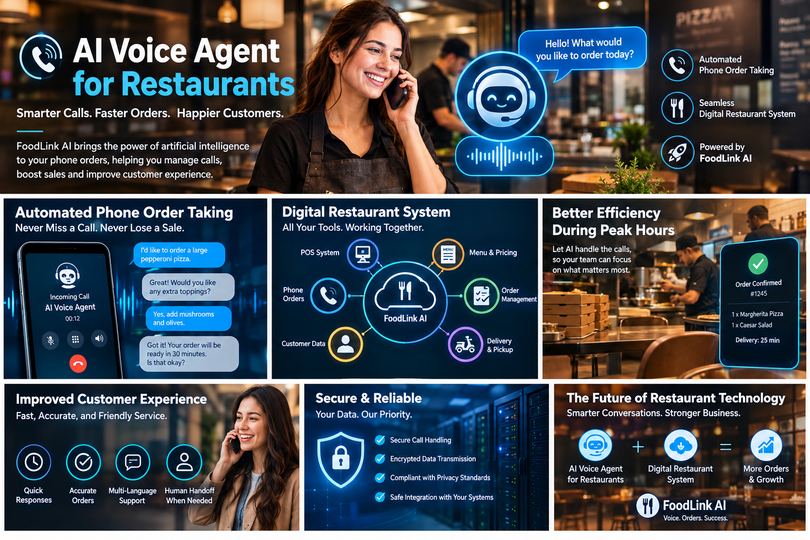

Restaurants are increasingly adopting artificial intelligence to improve customer service, manage busy periods, and reduce the workload on staff. While online ordering apps and digital menus have already changed how customers place orders, phone calls remain an important part of restaurant operations. During lunch and dinner rushes, however, staff may struggle to answer every call while preparing food, serving customers, and coordinating deliveries.
An AI Voice Agent for Restaurants offers a practical way to address this challenge. By using conversational AI to answer calls, understand customer requests, and support order-taking workflows, restaurants can make their phone operations more efficient. Projects such as FoodLink AI reflect the growing interest in connecting voice automation with modern restaurant technology.
Why Restaurants Need Smarter Phone Order Management
Phone orders can create unexpected pressure for restaurant teams. A busy restaurant may receive several calls at once, while employees are already managing customers at the counter and orders in the kitchen. Missed calls can mean missed sales opportunities, and rushed conversations can lead to incorrect items, incomplete delivery details, or confusion about special requests.
Traditional phone systems provide a communication channel but do not necessarily help staff manage the information received during each call. Employees must listen carefully, record the order, confirm the details, and transfer the information into the restaurant’s ordering workflow.
A voice-based AI solution can help automate parts of this process. Instead of requiring an employee to answer every routine call, an AI agent can greet customers, respond to supported questions, collect order details, and guide callers through a structured conversation.
The aim is not simply to replace a human voice with a digital one. It is to make the ordering process more consistent while allowing restaurant staff to focus on food preparation, hospitality, and other tasks that require human attention.
How an AI Voice Agent for Restaurants Works
An AI voice agent combines speech recognition, natural language processing, and voice generation to communicate with callers. Depending on its configuration, it can interpret spoken requests, identify relevant menu items, ask follow-up questions, and communicate the information to connected restaurant systems.
For example, a customer might call to order a pizza, request an additional topping, and ask how long delivery will take. The agent can identify the requested items, clarify missing details, and provide information available through its connected systems.
A well-designed workflow typically includes several stages:
- Call answering: The system greets the customer and identifies the purpose of the call.
- Order collection: It records requested items, quantities, modifications, and other necessary details.
- Clarification: It asks questions when a request is incomplete or ambiguous.
- Order confirmation: It repeats important details so the customer can correct mistakes.
- System integration: Where supported, it transfers the order to a point-of-sale system, order management platform, or kitchen workflow.
- Escalation: It transfers unusual requests or complicated situations to a human employee when necessary.
The exact capabilities depend on the technology and integrations available. Restaurants should verify whether a particular solution supports live menu availability, payment processing, delivery estimates, and direct order submission before deploying it.
FoodLink AI and the Digital Restaurant System
The development of FoodLink AI fits into a wider shift toward connected restaurant operations, where communication channels and ordering workflows increasingly work together. An AI voice agent can become more useful when it operates as part of a broader digital restaurant system, rather than functioning as an isolated phone-answering tool.
A connected system may link incoming calls with menu information, pricing, customer preferences, order records, and kitchen operations. This reduces the need for employees to transfer information manually between separate tools.
Consider a restaurant that updates its menu several times a month. If its voice agent uses outdated menu information, customers may be offered unavailable items or incorrect prices. Integration with a reliable source of menu data can help keep responses consistent with current offerings.
Similarly, order details should reach the appropriate staff members without unnecessary re-entry. Where the integration supports it, an order collected by the AI agent can be transferred directly into the restaurant’s established workflow.
For FoodLink AI specifically, restaurant owners should evaluate the documented features, supported integrations, and available deployment options rather than assuming every capability is included.
Automated Phone Order Taking During Peak Hours
One of the most practical applications of restaurant voice technology is automated phone order taking. During peak hours, the ability to handle routine calls consistently can reduce interruptions for employees and help customers complete their requests.
For example, imagine a local restaurant receiving a high volume of calls on a weekend evening. Staff members are preparing meals, coordinating collection orders, and assisting customers who are already inside. An AI voice agent can answer supported calls, collect order information, and confirm the details according to its configured workflow.
This can help reduce missed calls and limit the time employees spend repeating routine information. It may also provide a more consistent experience for customers calling outside the restaurant’s busiest periods.
However, automation does not automatically guarantee faster service or greater accuracy. Background noise, accents, unusual menu requests, and unclear speech can create challenges for voice recognition. Restaurants should test the system under realistic conditions and provide a straightforward way for customers to reach a human employee.
Order confirmation is particularly important. Before an order is submitted, customers should have an opportunity to verify items, quantities, modifications, and collection or delivery details.
Improving Customer Experience Without Losing the Human Touch
Restaurant service depends on more than taking orders quickly. Customers may ask about allergens, ingredient substitutions, dietary requirements, delivery policies, or special circumstances. An AI agent must recognize the limits of its information and avoid making unsupported promises.
For routine questions, the system can provide answers from approved restaurant information. For sensitive or complicated requests, it should direct customers to a staff member who can offer appropriate assistance.
Allergen handling deserves special attention. The agent should rely on verified restaurant information and escalate questions it cannot answer confidently. It should never guess whether a dish is safe for someone with a particular allergy.
A balanced approach combines automation with human oversight. Customers benefit from convenient access to routine information, while employees remain available for situations that require judgment, empathy, or detailed discussion.
Restaurants should also consider accessibility, language support, clear disclosure that callers are speaking with an AI system, and appropriate handling of recorded calls or customer information.
Integrating Voice AI With Existing Restaurant Technology
Successful deployment requires more than choosing a conversational AI platform. Restaurants must consider how the agent will interact with their existing telephone infrastructure, point-of-sale software, menus, payment systems, and order management tools.
Integration should be tested carefully to prevent duplicate orders, incorrect prices, missing modifications, or orders being sent to the wrong location. Restaurants with multiple branches may also need location-specific menus, opening hours, delivery zones, and pricing rules.
Security is another essential consideration. Systems handling customer names, phone numbers, addresses, or order histories should use appropriate access controls, secure data transmission, and clear retention policies. Any collection or recording of calls should comply with applicable privacy and consent requirements.
A phased rollout can help businesses identify problems before expanding the system. Starting with common questions or a limited set of menu items allows staff to evaluate accuracy, customer reactions, and operational impact.
Measuring the Value of Restaurant Voice Automation
Restaurant owners should evaluate voice AI using real operational data rather than relying on marketing claims. Useful measurements include the percentage of calls answered, the number of orders completed successfully, order correction rates, call abandonment, and the frequency of transfers to human staff.
Customer feedback can reveal whether conversations feel natural and whether callers can complete their requests without unnecessary repetition. Employees can also provide valuable insight into whether the technology reduces interruptions or introduces new administrative tasks.
Financial evaluation should consider implementation costs, integration fees, ongoing service charges, and the value of any recovered orders. Results will vary according to call volume, menu complexity, system reliability, and customer preferences.
Regular reviews allow restaurants to improve conversational scripts, correct menu information, and refine escalation procedures as operating conditions change.
The Future of AI-Powered Restaurant Operations
Voice automation is becoming an important part of the broader transformation of restaurant technology. By connecting conversational AI with ordering and management workflows, restaurants can create more consistent ways to handle routine calls while keeping employees focused on food quality and customer service.
An AI Voice Agent for Restaurants can support this transition when it is built around reliable information, carefully tested integrations, and clear human escalation paths. For initiatives such as FoodLink AI, the opportunity lies in connecting phone conversations with the wider digital restaurant system instead of treating each call as a separate task.
The most successful implementations will not depend on automation alone. They will combine useful AI capabilities with accurate menus, secure data handling, transparent customer communication, and ongoing performance measurement. This balanced approach can help restaurants modernize phone ordering while preserving the personal service that keeps customers coming back.